Dr. Cecilia Maria Vallorani: Reclaiming Human Connection in the Age of AI
In this special edition of The Pulse Magazine, we spotlight Dr. Cecilia Maria Vallorani EdTech visionary, researcher in AI, gamification, and digital orality, and Founder & CEO of EchoEd whose work challenges the assumption that technological advancement must come at the expense of human presence.

Where Ai, Sound & Storytelling Redefine Learning : Cecilia Vallorani, Ph.D
In an era defined by acceleration, automation, and artificial intelligence, one question rises above the noise:
What remains uniquely human in education?
In this special edition of The Pulse Magazine, we spotlight Dr. Cecilia Maria Vallorani EdTech visionary, researcher in AI, gamification, and digital orality, and Founder & CEO of EchoEd whose work challenges the assumption that technological advancement must come at the expense of human presence.
This is not simply a story about AI.
It is a story about listening.
The Future Speaks in Stories
Before standardized metrics, before dashboards and data analytics, humans learned through narrative.
Dr. Vallorani’s research does not reject technology. Instead, it reframes it. Her philosophy positions AI as augmentation not replacement. She advocates for systems where artificial intelligence supports cognitive and emotional engagement rather than diminishing it.
“The future classroom will not be defined by screens alone. It will be defined by presence. And presence begins with listening.”
Her work in digital orality integrates sound-based pedagogy, immersive storytelling, and adaptive AI systems to restore emotional connection to learning environments.
AI as Architecture, Not Authority
The conversation around AI often centers on efficiency, automation, and predictive systems. But Dr. Vallorani argues that efficiency without empathy creates fragile systems.
Her leadership philosophy rests on three pillars:
- Human-centered design
- Ethical AI integration
- Cognitive-emotional engagement
AI should not dictate learning. It should enhance it.
The recalibration is simple yet radical:
Technology must serve human growth not define it.
Redefining Learning Through Digital Orality
At the heart of her research lies digital orality the study of how sound, narrative rhythm, and spoken engagement influence cognitive retention and comprehension.
Where traditional models emphasize visual consumption, Dr. Vallorani’s work highlights:
- Emotional resonance through voice
- Narrative immersion as a memory anchor
- Sound as a pedagogical strategy
In doing so, she reintroduces something education quietly lost: attention rooted in meaning.
Leadership in an Age of Algorithms
The most transformative leaders, as highlighted in this edition of The Pulse Magazine, are architects of invisible systems.
Dr. Vallorani’s leadership reflects:
- Strategic foresight
- Ethical accountability
- Inclusive innovation
- Interdisciplinary integration
Her work at EchoEd demonstrates how AI, gamification, and digital storytelling can coexist within a values-driven educational framework.
This is leadership not driven by trend but by intention.
Human Before Digital
Artificial intelligence can process information.
But it cannot replace human nuance, empathy, or narrative depth.
As educational institutions worldwide integrate AI-driven systems, the real challenge is not technological capability it is philosophical clarity.
What are we building?
And who does it serve?
Dr. Vallorani’s work answers this with conviction:
AI must expand human potential, not compress it.
The Pulse Perspective
This edition of The Pulse Magazine goes beyond innovation headlines to examine the deeper architecture behind educational transformation.
We explore:
- The ethics of AI in classrooms
- The role of sound and narrative in cognitive engagement
- The future of human-centered learning design
- Leadership in technological disruption
In a world obsessed with automation, Dr. Cecilia Maria Vallorani reminds us of something revolutionary:
Listening is a design principle.
Final Reflection
The future of education is not purely digital.
It is relational.
It is built not just on systems but on intention.
And perhaps, in learning to listen again, education may rediscover its greatest strength.
This edition of The Pulse Magazine invites readers to rethink leadership, reframe ambition, and recommit to building organizations that endure beyond trends, cycles, and personalities.
Where Every Story Matters.
Must Read The Pulse Journey
Related Stories
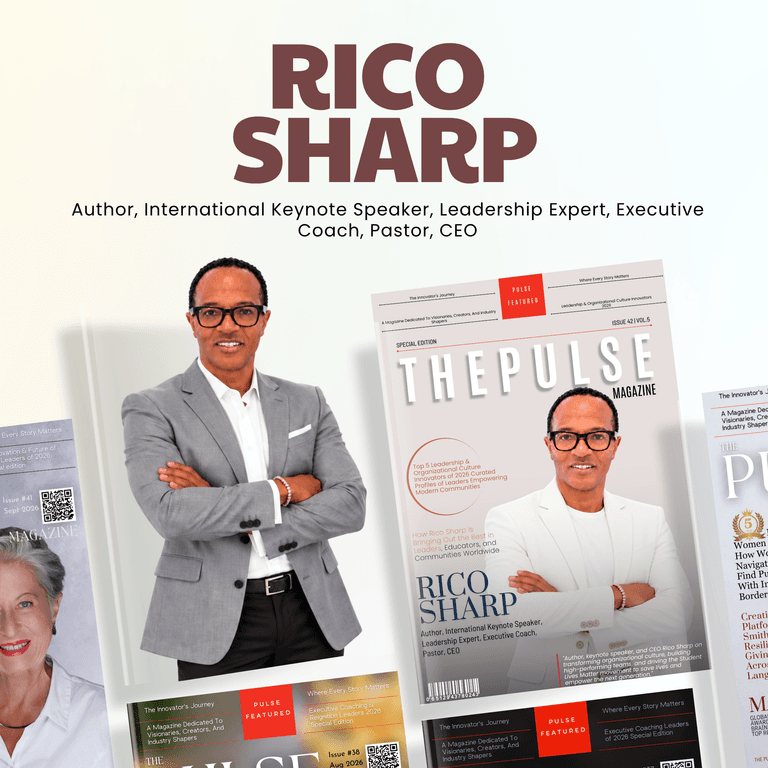
The WHO Factor: How Rico Sharp is Redefining Leadership and Organizational Culture
Author, international keynote speaker, and CEO. Beginning his transformational journey from a prison cell at age nineteen, Rico Sharp has spent three decades empowering leaders and communities worldwide. In this exclusive Pulse Magazine feature, Sharp reveals why organizations must hire for the "WHO" (character and integrity) rather than just the "WHAT" (credentials). He shares the philosophy behind his renowned leadership academies and explains how the Student Lives Matter movement is shifting the national paradigm from reactive crisis response to proactive violence prevention.

Augmenting Humanity: How Dr. CJ Meadows is Redefining Business Education for the AI Era
Harvard DBA. Author of 13 books. IDEO+ExperiencePoint-certified facilitator and innovation ecosystem builder. In this exclusive Pulse Magazine feature, Dr. CJ Meadows reveals why generative AI will not replace human leaders, but rather augment them to focus on what humans do best. Drawing on over three decades of consulting and teaching, she shares the design thinking philosophy shaping executives at S P Jain School of Global Management, and explains why true digital transformation is always 75% human work.

How Deborah Levine's Matrix Model Is Reshaping Cross-Cultural Communication and Emotional Intelligence
One month before September 11th, she founded a diversity council in a small Southern city. Then the towers fell, and dialogue was no longer enough. In this exclusive Pulse Magazine feature, Harvard-educated Forbes Trailblazer Deborah Levine reveals how that moment of crisis gave rise to the Matrix Model — a cross-cultural framework now used at Fortune 500 corporations and international AI conferences. She shares why storytelling, not policy or research, is the technology that actually builds cross-cultural intelligence, and why restoring our humanity across difference is no longer optional.