From Potential to Performance: How Colby B. Jubenville, PhD Is Redefining Leadership and Human Growth
In a world obsessed with speed, visibility, and instant validation, leadership is often measured by titles rather than transformation. But what if success isn’t about how fast you rise but about how deeply you understand who you are? This is the central question behind the work of Colby B. Jubenville, PhD TEDx speaker, human performance

Colby-B.-Jubenville
In a world obsessed with speed, visibility, and instant validation, leadership is often measured by titles rather than transformation. But what if success isn’t about how fast you rise but about how deeply you understand who you are?
This is the central question behind the work of Colby B. Jubenville, PhD TEDx speaker, human performance scholar, author, and Founder of the Center for Student Coaching & Success.
For deeper insight into his philosophy, frameworks, and published work, readers can explore his official platform at: www.drjubenville.com www.mtsu.edu/cbhssuccess
His philosophy is simple but disruptive:
Clarity does not come before action. It is forged through it.
The Early Ceiling That Shaped a Philosophy
Before Colby advised executives or built coaching systems, others had already drawn a ceiling around his life.
As a child, doctors diagnosed remnants of the pupillary membrane what he described as “spider webs across his eyes.” His parents were gently warned not to expect too much.
That experience planted a defining question:
Who gets to decide the limits of your life?
Rather than internalize prediction, he internalized responsibility. That distinction would later become the foundation of his work.
Sports: The First Truth System
Athletics became his first laboratory of human performance.
Sports offered something rare:
- Effort had consequences.
- Preparation showed.
- Excuses were exposed.
In sports, there was no narrative protection. Performance was honest.
This environment taught him something most people misunderstand:
Confidence doesn’t precede clarity.
Clarity follows disciplined action.
That lesson became a lifelong framework.
Where Performance Meets Identity
Over two decades in higher education, Colby observed a pattern:
Two individuals.
Same coach.
Same resources.
Wildly different outcomes.
The difference wasn’t intelligence. It wasn’t access. It wasn’t even effort.
It was identity.
People who understood:
- Who they were.
- How they created value.
- What standards they lived by.
…thrived.
Those who didn’t often borrowed identity from titles, roles, or external validation until pressure exposed the weakness.
His conclusion?
Most performance problems are not performance problems at all.
They are identity problems under pressure.
The Relationship That Changes Everything
Students who thrived after graduation had one meaningful relationship during college.
Not ten. Not a support system.
One.
Colby defines meaningful relationship precisely:
Two people working together through interdependence toward a common goal.
This became the structural backbone of the Center for Student Coaching & Success.
The Center for Student Coaching & Success
The Center was not created as a “support service.”
It was built as a developmental partnership.
Instead of asking:
- What classes are you taking?
- What requirements remain?
Colby asked:
- Who are you becoming?
- What patterns are repeating?
- What responsibility are you avoiding?
The framework operates through three movements:
1. Realization
What is your greatest realization from today?
2. Result
What does that realization mean?
3. Activity
What will you commit to in the next 30 days?
This system forces clarity and removes rescue.
Because rescue creates relief.
Responsibility creates change.
Why Intelligence Was Never the Issue
One of the quiet crises Colby observed was this:
Students didn’t fail because they lacked intelligence.
They failed because no one slowed down long enough to say:
“Let’s talk about what’s actually happening with you.”
Without language for confusion, students drifted.
And drifting is education’s most expensive failure mode.
Coaching interrupted drift.
It replaced:
- Compliance → Ownership
- Performance → Honesty
- Avoidance → Accountability
From Campus to C-Suite
When Colby moved into executive advisory work, something striking happened.
The pattern didn’t change.
The room was different.
The suits were sharper.
The stakes were higher.
But the identity gaps remained.
Under pressure, leaders fall not to the level of strategy but to the level of identity.
Executives often ask for:
- Alignment
- Culture change
- Execution improvement
But the real issue is usually simpler:
They have not reconciled who they are becoming with the responsibility they carry.
The Trusted Advisor Difference
Colby draws a clear line:
A consultant delivers answers.
A trusted advisor stays with consequences.
He does not rescue leaders.
He confronts them respectfully and consistently.
Questions he asks executives include:
- What are you protecting right now?
- What happens if you don’t act?
- What standard are you actually setting?
Clarity feels dangerous.
But confusion becomes more expensive over time.
Because of You, My Life Is Better
At some point, ambition evolves.
The question shifts from:
“How far can I go?”
To:
“What actually lasts?”
A line from former Texas Governor Ann Richards reframed his thinking:
“Because of you, my life is better.”
That became the ultimate metric.
Not scale.
Not recognition.
Not applause.
But presence.
Books as Tools, Not Monuments
Colby’s books reflect this philosophy:
- Zebras and Cheetahs Why organizations pay for value, not time
- Me: How to Sell Who You Are, What You Do, and Why You Matter Helping individuals articulate their worth
The goal was never admiration.
It was application.
If the reader couldn’t act differently tomorrow, the work wasn’t complete.
What the Center Ultimately Protects
The Center for Student Coaching & Success protects students not from hardship but from drifting.
From graduating with competence but no clarity.
From entering careers that look impressive but feel misaligned.
Because talent without architecture collapses under pressure.
Identity is the architecture.
The Final Measure
In a world chasing visibility, Colby chose depth. In a culture chasing scale, he chose presence. And in systems that reward noise, he chose responsibility. If his life were reduced to one question, it would be this:
When the noise fades, can someone honestly say:
“Because of you, my life is better.”
That is not built through achievement.
It is built through staying.
This edition of The Pulse Magazine invites readers to rethink leadership, reframe ambition, and recommit to building organizations that endure beyond trends, cycles, and personalities.
📖 Where Every Story Matters.
Must Read The Pulse Journey
Related Stories
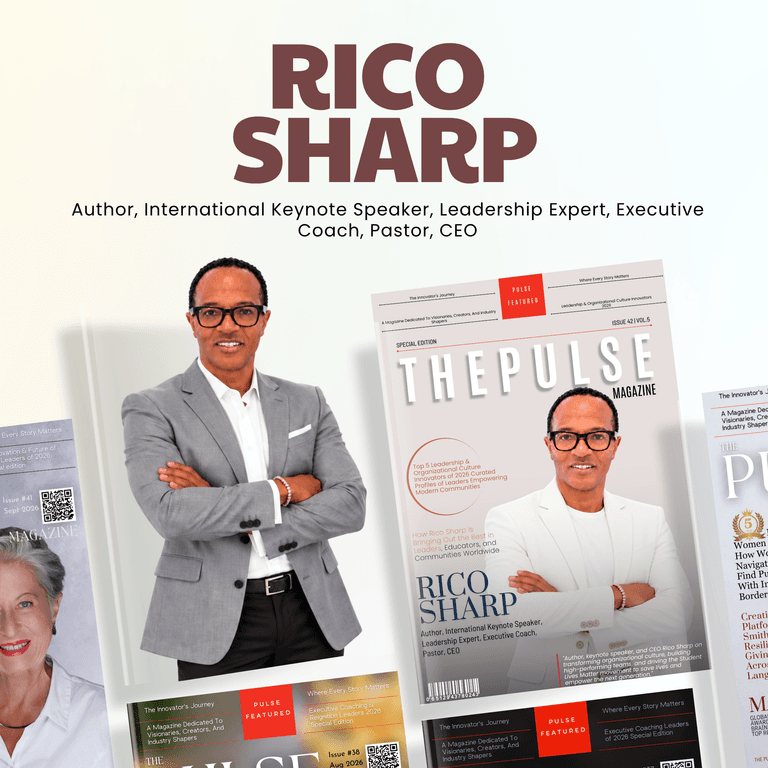
The WHO Factor: How Rico Sharp is Redefining Leadership and Organizational Culture
Author, international keynote speaker, and CEO. Beginning his transformational journey from a prison cell at age nineteen, Rico Sharp has spent three decades empowering leaders and communities worldwide. In this exclusive Pulse Magazine feature, Sharp reveals why organizations must hire for the "WHO" (character and integrity) rather than just the "WHAT" (credentials). He shares the philosophy behind his renowned leadership academies and explains how the Student Lives Matter movement is shifting the national paradigm from reactive crisis response to proactive violence prevention.

Augmenting Humanity: How Dr. CJ Meadows is Redefining Business Education for the AI Era
Harvard DBA. Author of 13 books. IDEO+ExperiencePoint-certified facilitator and innovation ecosystem builder. In this exclusive Pulse Magazine feature, Dr. CJ Meadows reveals why generative AI will not replace human leaders, but rather augment them to focus on what humans do best. Drawing on over three decades of consulting and teaching, she shares the design thinking philosophy shaping executives at S P Jain School of Global Management, and explains why true digital transformation is always 75% human work.

How Deborah Levine's Matrix Model Is Reshaping Cross-Cultural Communication and Emotional Intelligence
One month before September 11th, she founded a diversity council in a small Southern city. Then the towers fell, and dialogue was no longer enough. In this exclusive Pulse Magazine feature, Harvard-educated Forbes Trailblazer Deborah Levine reveals how that moment of crisis gave rise to the Matrix Model — a cross-cultural framework now used at Fortune 500 corporations and international AI conferences. She shares why storytelling, not policy or research, is the technology that actually builds cross-cultural intelligence, and why restoring our humanity across difference is no longer optional.